In the battery industry, the term "Shelf Life" generally encompasses two distinct meanings:
Charge Retention (Self-Discharge Rate): If fully charged and put in a drawer, how long until the battery goes dead?
Calendar Life (Total Lifespan): Even if never used, how many years will the battery's chemistry last before degrading?
Below is a comparison of the pros and cons of Lithium batteries (specifically Li-ion/Li-Po) and Nickel-Metal Hydride batteries (NiMH) regarding these two dimensions:
General Characteristics: High energy density, ready to use, but chemically active with "natural aging" characteristics.
Pros:
Extremely Low Self-Discharge (Holds charge well): The monthly self-discharge rate is typically only 1% - 5%. This means if you store it fully charged for six months or even a year, it will still have power when you take it out. This is great for occasional use (e.g., camera backup batteries).
No Memory Effect: Can be charged or stored at any time; no need to "drain completely before charging" like older battery technologies.
The King of Disposables (Primary Lithium): If referring to non-rechargeable Lithium Iron batteries (like Energizer Ultimate Lithium), their shelf life can reach 10-20 years. They are the best consumer batteries for long-term storage, perfect for emergency kits or smoke detectors.
Cons:
Irreversible Calendar Aging (Fears "Old Age"): From the moment it leaves the factory, the internal chemistry begins to degrade, regardless of usage. Typically, the calendar life is about 3-5 years, after which capacity drops significantly.
Risk of "Deep Discharge Death": If stored at a low charge level for a long time (e.g., stored at 0% for 6 months), the voltage may drop below the protection circuit's cut-off threshold. This causes permanent damage, rendering the battery unable to accept a charge again.
Sensitive to Storage Environment: Storing at full charge in high temperatures accelerates aging (e.g., leaving a fully charged battery in a hot car in summer will drastically reduce its lifespan).
General Characteristics: Safe and stable, the best alternative to alkaline dry cells, but traditional models "leak" charge quickly.
Pros:
The Breakthrough of Low Self-Discharge (LSD): Note: This is the key differentiator.
Standard NiMH: Huge disadvantage. A full charge might drain itself in a month.
LSD NiMH (e.g., Panasonic Eneloop): Excellent performance. They can retain 70% capacity even after 5 to 10 years of storage after a full charge. In terms of long-term charge retention, high-quality LSD NiMH batteries are arguably better than standard Lithium-ion batteries.
Resilient to Over-Discharge: Even if a NiMH battery is accidentally drained to 0V, it can usually be "revived" and recharged. They are not as prone to immediate failure as Lithium batteries are.
Long Calendar Life: With proper maintenance, high-quality NiMH batteries can last 5-10 years.
Cons:
High Self-Discharge in Standard Models (Major Drawback): If you buy non-LSD (standard) NiMH batteries, the monthly self-discharge rate can be as high as 20%-30%. You might charge them, put them in a drawer, and find them dead when you need them next month.
Memory Effect (Slight): Although much better than the old Nickel-Cadmium (NiCd) batteries, they can still lose some capacity if not fully cycled occasionally (though this can be fixed via a "refresh" cycle).
Summary & Comparison
| Aspect | Lithium-ion (Li-ion) | LSD NiMH (e.g., Eneloop) |
| Used after 6 months storage | Excellent (90%+ charge remains) | Excellent (85%-90% charge remains) |
| Used after 3 years storage | Average (Risk of deep discharge damage or capacity decay) | Good (Still holds charge; battery chemistry likely intact) |
| Total Calendar Lifespan | 3-5 Years (Natural chemical degradation) | 5-10 Years (High-quality brands) |
| Worst Storage Method | Stored at Low Charge (Risk of permanent death) | High Temp Storage (Accelerates decay) |
The choice largely depends on the application's power draw.
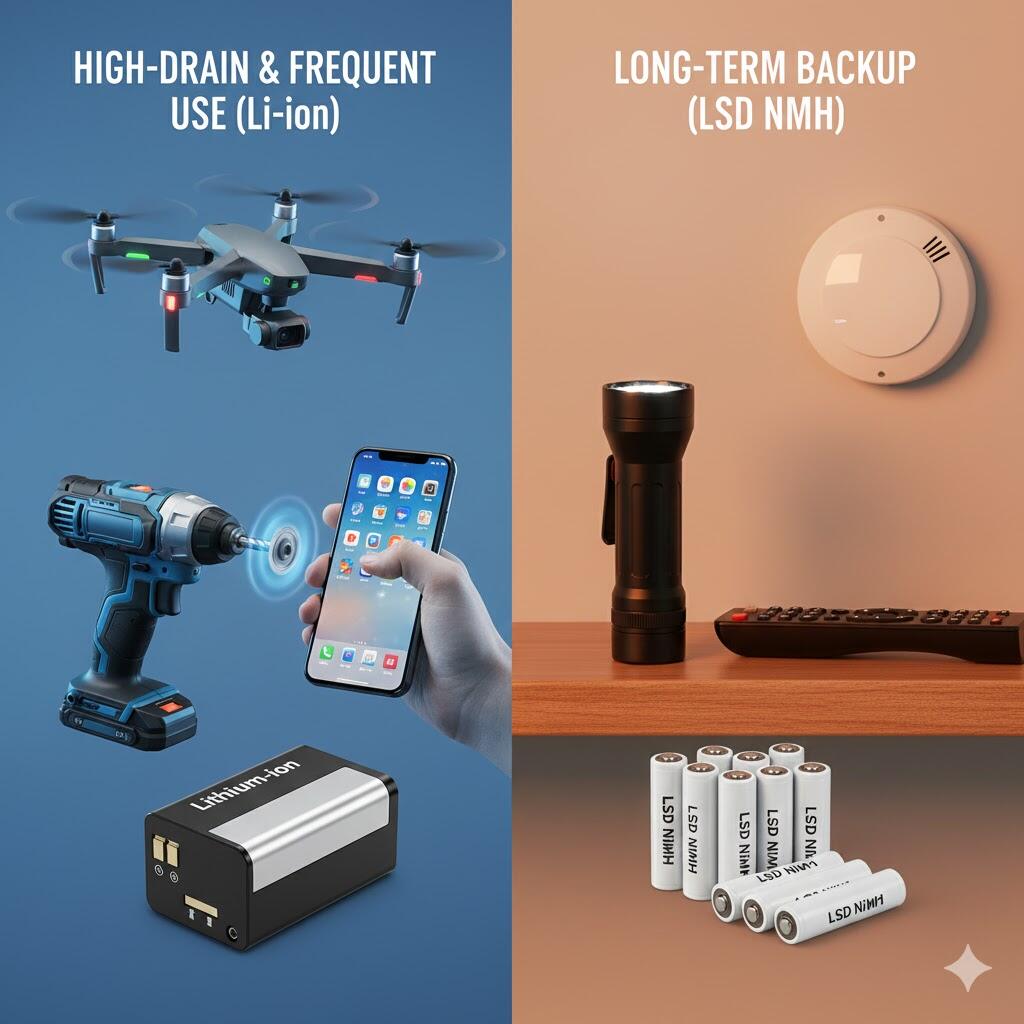
For Long-term Storage/Backup (Remote controls, flashlights, emergency kits): Highly recommend Primary (Disposable) Lithium Batteries (the strongest option) or Low Self-Discharge (LSD) NiMH (e.g., White Eneloop, IKEA LADDA).
For High-Frequency/High-Drain Use (Phones, drones, power tools): Lithium-ion is the only choice due to its high energy density and light weight.
Pitfall to Avoid: Try not to buy "Standard/High Capacity NiMH" (non-LSD) for backup purposes, or you will likely face a "dead battery" situation when you need it most.
Looking for reliable batteries with long shelf life for your market? Contact Tiger Head today for a customized quote on our Li-ion battery series.
 Hot News
2026-04-13
2025-12-10
2025-12-08
2025-11-19
2025-10-19
2025-11-24

Tiger Head Battery Group main product USB Rechargeable Batteries, Micro USB Rechargeable Batteries, Type-C Rechargeable Batteries, Car Jump Starter, With Air Compressor, Battery& Charger, ect.
No.132 North, Gongye Road, Haizhu District, Guangzhou, China
Copyright © 2024 Guangzhou Tiger Head Battery Group Co.,Ltd. Privacy Policy

 EN
EN
 BG
BG
 CS
CS
 HR
HR
 DA
DA
 NL
NL
 FI
FI
 FR
FR
 DE
DE
 EL
EL
 HI
HI
 IT
IT
 JA
JA
 KO
KO
 NO
NO
 PL
PL
 PT
PT
 RO
RO
 RU
RU
 ES
ES
 SV
SV
 IW
IW
 HU
HU
 ID
ID
 LT
LT
 SK
SK
 SL
SL
 VI
VI
 ET
ET
 TH
TH
 TR
TR
 FA
FA
 KA
KA
 BN
BN
 HA
HA
 TA
TA
 YO
YO
 KK
KK
 AR
AR